An Excursion Into Heraldry:
The Unarmigerous Author Pauses
To Blazon His Armorial Achievement Though I am not to the manor born…
Author unknown. Sometimes

 attributed to Kit Marlowe.
What is an armorial achievement?
An armorial achievement is a display
of the heraldic elements to which an
armiger (bearer of arms) is entitled.
Its principal feature is the coat of arms.
Other components frequently found are
a crest, a pair of supporters, and a helm.
Hoi polloi think a coat of arms is a
family logo or registered trademark
anyone in their whole clan can claim.
Wrong. A coat of arms is granted
to an individual. Not to a family.
The arms are often inherited by males
in the bearer's direct line. They shouldn't
be appropriated by some random relative
who happens to share the same surname.
Maybe your rich uncle Paul has a coat of arms
he and his progeny love to plaster everywhere.
The arms are painted on their great room wall.
Embossed on china and silverware, flaunted on
ties and cufflinks, business and Christmas cards.
They hoist it on a flagpole in their front yard,
have jigsaw picture puzzles made for the kids,
and several confess it is tattooed on their torso.
Uncle Paul himself will smugly tell you
he intends to have the damn thing carved
on the gravestones in the family boneyard.
This does not mean you've got the right to
use it on your Yule greetings. People say
in Scotland you go to prison if you do.
The coat of arms is usually shown on an escutcheon
(a shield) and blazoned (described) in the archaic,
highly stylized language of heraldry, a mixture
of English, French, and Latin. A specimen:
Argent, a holly tree eradicated vert,
thereon a lizard passant Or, a bordure
counter-componée of the first and second.
Freely translated into modern English
On a field of silver stands a
holly tree. Although its roots are
exposed, the holly is green.
A golden lizard strides
across the holly's leafy crown,
tail and one foreleg raised.
The entire assemblage is
surrounded by two rows of
silver and green oblongs.
Someone else’s coat of arms, not mine.
I'm unarmigerous, a bohemian scribbler
of working class origin who doesn't own
a decent top coat much less a coat of arms.
Devising one will offer this rhymester
a welcome respite from his sullen art.
To begin my excursion into heraldry
I'll borrow the above bit of blazonry.
We poets do not stand on the shoulders
of those poets who came before us, we
lurk behind them to pick their pockets.
The first word of the blazon specifies
the color of the shield. Here it is argent,
silver, the escutcheon is "a field of silver".
Silver is a precious metal. I like
it. My escutcheon will be argent.
Then comes a holly tree eradicated vert.
My tree is certainly an American holly.
Eradicated suggests it is ready to be planted.
Me too, though I am grey instead of green,
which is what the French word vert means.
Heraldry’s limited palette has no grey so
I could tint my elderly tree a youthful vert.
However I prefer polychrome to mono.
A brown trunk, green for the leaves,
and bunches of bright red berries.
In the formal language of blazonry, a
holly tree eradicated fructed proper.
Lizards are delightful creatures but a
lizard passant Or is too tame for me.
The creature on my escutcheon
is far fearsomer than any lizard.
Do I want a lion? Or a wyvern?
No, I'll have me a standard dragon.
Quadrupedal, winged, fire-breathing.
I won't use passant which implies an absence
of panache. I desire a spirited critter, not a timid
one. And upright, in the attitude termed rampant.


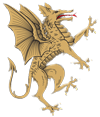
Wait, he is a dragon standing tall with
his wings raised. That's called segreant.
Furthermore, the French word Or — which
is normally capitalized in English to avoid
confusion with our "or" — denotes gold.
Not gold ore, pure gold, a precious
metal that is untarnishable by time.
My beast has been considerably
tarnished by time. No matter,
dragons live for millennia.
He is an old yet still bold black
dragon, a dragon segreant sable.
Next, a bordure counter-componée.
Two rows of blocks in alternating colors
forming a border around the escutcheon.
Felicitously describing my checkered
life with the dark and the light periods
forever changing, never commingling.
Of the first and second.
This refers to the first and second colors,
namely argent and vert or silver and green.
Which seems quite fitting.
I am William III, the firstborn son
of William II, the son of William I.
But since proper has replaced
vert, I have no first and second.
And as I am a widower, one row
suits me. I'll make my own border
bordure componée argent and vert.
Bereft of father and wife, I am
undifferenced and unimpaled.
No bother about cadency, the brisure
declaring I was my father's eldest son.
Lacking elements most achievements
boast — the crest, a helm, mantling,
and more — mine is unimposing.
To compensate for these deficiencies a
motto could be added, a reminder of the
wingèd chariot always hurrying nearer.
I am aware that time is gaining on me.
Carpe Diem? Tempus Fugit?
Timeworn, overused, refused.
Also refused are abatements of honor.
Including the gusset sanguine, despite
what a few former "friends" might say.
I will allow myself an augmentation.
A pen — a quill pen of course —
with a drop of ink. Better, two
drops, and of blood not ink:
A golden quill pen with
two drops of blood at its tip
set upon a small blue shield in
the lower part of the escutcheon.
It is done.
This plebeian poet de Kypia
has crafted his escutcheon, the
which he proudly blazons thusly
Argent, an American holly
tree eradicated fructed proper,
thereon a dragon segreant sable, a
bordure componée of argent and vert.
As an augmentation, on the nombril
point an inescutcheon azure charged
with a quill pen Or, and from its tip
two gouttes de sang depending.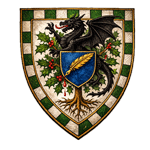
Distressingly, an escutcheon does not turn a
commoner into a lord so the stricter heraldists
will likely deem mine mere arms of pretension.
Patronizing purists will sneer that my endeavor
flouts the laws of God. And those of heraldry.
At least I didn't violate the rule of tincture.
Hereditary armigers will despise me as a
crass social climber and disdain my arms
as a partial achievement versus a full one.
Thereby providing not a motto for climbers
but a credo for all who have goals or dreams:
Fieri Quam Esse: To become rather than to be.
Now, since I do have both goals and dreams,
and because tempus truly fugits, I must put
down my arms to take up the pen again.
A fresh golden quill awaits me.
William de Kypia, Esq.