Will de Kypia
ABATEMENT
A modification of an existing achievement
imposed to indicate reprehensible conduct.
ARGENT
A metal, silver or white.
ARMIGER
A person or entity entitled to bear heraldic arms.
ARMORIAL ACHIEVEMENT
A display of the heraldic elements
to which an armiger is entitled. The
principle feature is a coat of arms.
Also called armorial bearings, heraldic
achievement, or simply achievement.
ARMS
May refer to an achievement
or to the coat of arms alone.
ARMS OF PRETENSION
Arms that denote a claim to a rank or
realm by one not in possession of it.
ATTITUDE
Specifies the stance adopted by an
animal or person in an achievement.
AUGMENTATION
An addition to an existing achievement
granted to reward meritorious service or
to recognize significant accomplishments.
AZURE
A colour, blue.
BEARINGS
Armorial bearings, i.e., an achievement.
BLAZON, n.
A display or a formal description
in heraldic terms of an achievement.
BLAZON, v.
To depict or to formally describe
an achievement in heraldic terms.
BORDURE
A border.
BRISURE
Marks used on an escutcheon by the
descendants of the holder if they have
not been granted arms in their own right.
Brisures are also used to differentiate a
family's cadet branches from its main line.
CADENCY
A system of brisures used by sons on an
escutcheon to indicate their order of birth.
An eldest son displays his until the father dies.
CARPE DIEM
Latin, Seize the day.
CHARGE, n.
A graphic element (such as an emblem,
a symbol, or a geometrical figure) that
is placed on the field of an escutcheon.
CHARGE, v.
To place a graphic element
on the field of an escutcheon.
COAT OF ARMS
Strictly, refers those heraldic elements
that are displayed upon the escutcheon.
Also used for the whole achievement.
COLOUR
A type of tincture. The five standard colours
are azure (blue), gules (red), purpure (purple),
sable (black), and vert (green). Some heraldic
traditions allow various additional colours.
COMPONÉE
One row of quadrilaterals
in two alternating tinctures.
COUNTER-COMPONÉE
Two rows of quadrilaterals
in two alternating tinctures.
CREST
An ornament placed on top of the
helm. Informally, the coat of arms.
DEXTER
Right side
DIFFERENCE
A mark added to an escutcheon to distinguish
one branch or member of a family from another.
DRAGON

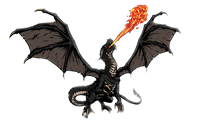
Any of numerous mythical creatures that occur
in cultures around the globe. In heraldry they
are often winged, fire-breathing quadrupeds.
ESCUTCHEON
A shield displaying a coat of arms,
the central element of an achievement.
Also used for the coat of arms itself.
FIELD
The background of an escutcheon.
FIERI QUAM ESSE
Latin, To become rather than to be.
FULL ACHIEVEMENT
An achievement that includes all of the
elements to which an armiger is entitled.
FUR
A type of tincture that represents an
animal pelt. The two common furs are
ermine and vair (a variety of squirrel).
GOUTTE
A drop.
GULES
A colour, red.
GUSSET SANGUINE
A charge that some consider
to be an abatement indicating
specific dishonorable behaviors.

HELM
A helmet placed above the
escutcheon in an achievement.
IMPALEMENT
The placement of two coats of arms
side-by-side on the same escutcheon.
Impalement usually signifies marriage.
INESCUTCHEON
A small shield placed upon the escutcheon.
MANTLING
Drapery attached to a helm.
METAL
A type of tincture. The two standard metals are
argent (silver or white) and Or (gold or yellow).
NOMBRIL POINT
The area of an escutcheon halfway between
the center of the escutcheon and its base.
OF THE FIRST AND SECOND
Pigmented with the first two
tinctures named in a blazon.
OR
A metal, gold or yellow.
Often capitalized in English.
ORDINARY
A charge that is a simple and
common geometrical figure.
PARTIAL ACHIEVEMENT
An achievement that does not include all
elements to which an armiger is entitled.
PASSANT
Of an animal, walking with
right forefoot and tail raised.
PROPER
Of a charge, depicted in its natural colours.
PURPURE
A colour, purple.
RAMPANT
Of an animal, standing on one hind
leg with three legs and the tail raised.
SABLE
A colour, black.
SANGUINE
A stain (non-standard tincture), blood-red.
SEGREANT
Of a winged creature, standing on
its hind legs with its wings elevated
and addorsed (placed back to back).
SINISTER
Left side
SUPPORTERS
Two figures of animals or persons
placed at the sides of the shield
depicted as holding it upright.
TEMPUS FUGIT
Latin, Time flies.
TINCTURES
The colours, metals, and furs
used as pigments in heraldry.
The rule of tincture prohibits placing
metal on metal and colour on colour.
This rule is widely accepted, but
it has numerous exceptions and
many coats of arms violate it.
UNARMIGEROUS
Not armigerous.
VERT
A colour, green.
WYVERN
A two-legged winged dragon with a pointed,
venomous tail. Generally not fire breathing._________________
ZEBRA
A black-and-white striped African
equine sometimes used in heraldry.
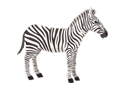


 Zebras are never
 fire-breathing.

 About the Author